Liminal Thinking
Beliefs are compression. Reality is too large to carry around, so we reduce it to a few remembered facts, labels, and stories. That reduction makes action possible. Trouble starts when the shortcut becomes invisible and we confuse what our mind kept with all there is.
Liminal Thinking is a book and framework by Dave Gray, recommended to me by Emily Campbell. These are my annotations on Gray’s
six principles and
nine practices, not a reproduction of the book.
Made with 5.6 Sol (High).
Six principles: how beliefs work
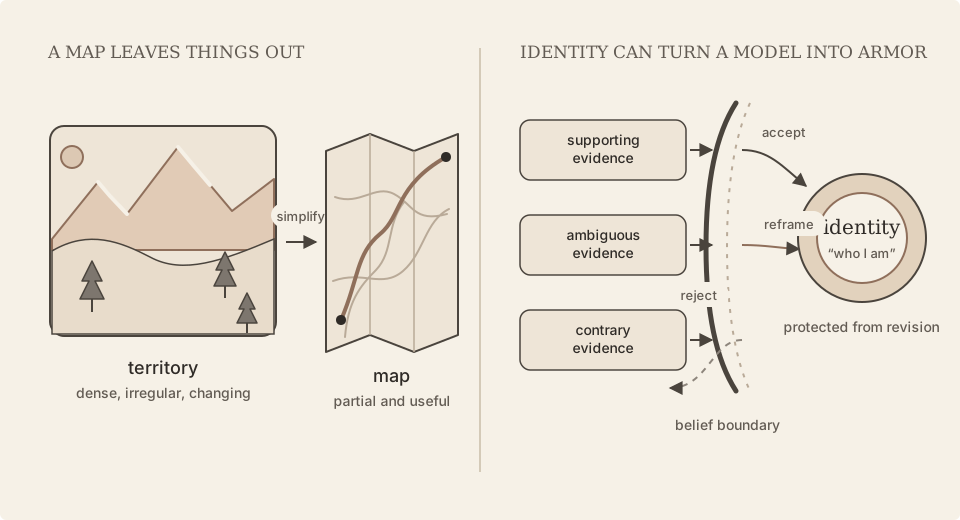
- Beliefs are models. A belief is a map, not the territory. A useful map leaves out trees, potholes, and the smell of the air so that a route can be seen. A belief does the same kind of editing. Its omissions are the reason it works and the reason it can mislead.
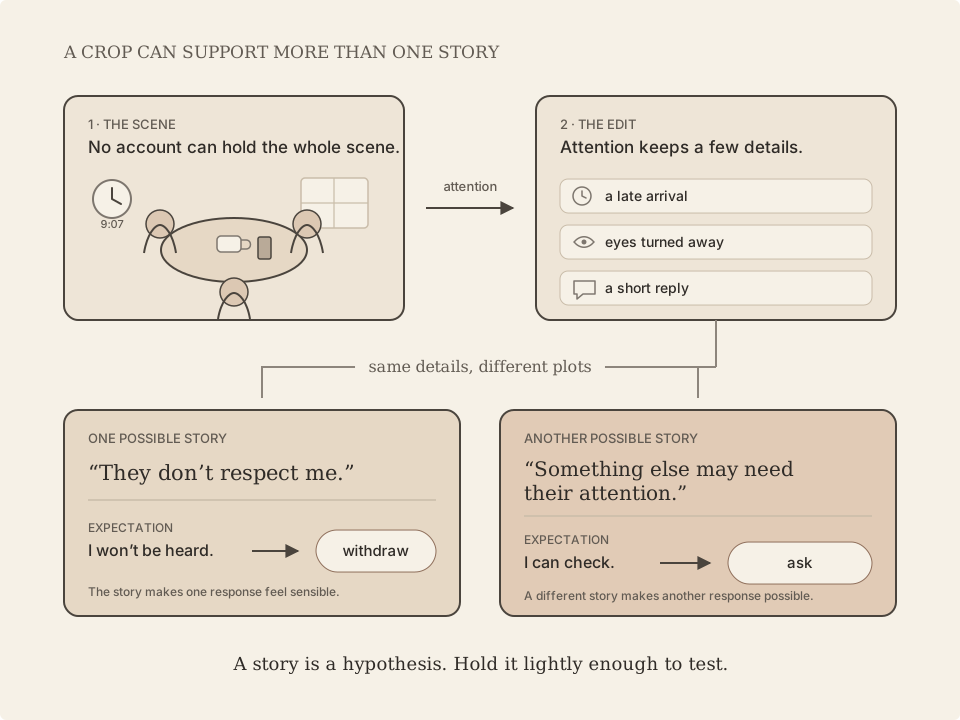
- Beliefs are created. Experience does not arrive as a complete record. Attention crops the scene, memory keeps a few pieces, and narrative decides how they fit together. “She looked away” can become “she dismissed me,” but it could also become “something else needs her attention.” Neither story is the scene itself. Each creates a different expectation and makes a different action feel sensible. Two people can share a room and leave with sincere, incompatible stories because each noticed and connected different details.
- Beliefs create a shared world. A group needs enough agreement to move together. Money works because people agree it counts; a meeting works because people share expectations about who speaks and what a decision means. These agreements are less like physical laws and more like rules of a game: real in their consequences, but still made by the players.
- Beliefs create blind spots. A belief is also a path through tall grass. The more often it is walked, the easier it becomes to follow and the harder the other routes are to see. “This is how we do it” may describe habit rather than necessity.
- Beliefs defend themselves. Contradicting evidence does not always update a belief. Sometimes the belief behaves like an immune system: it labels the evidence as confused, biased, or hostile before the evidence can get close. A model that can explain away every possible objection cannot be tested; it can only be protected.
- Beliefs are tied to identity. Some beliefs sit close to “the kind of person I am.” Questioning them can feel less like correcting a map and more like removing armor in public. Ask two questions: “Could this be wrong?” and “What am I afraid would become true about me if it were?”
Nine practices: revise your thinking
- Assume that you are not objective. Start by writing down your stake in the outcome. What do you want to be true? What would be embarrassing to admit? Bias is easier to notice when it has a name.
- Empty your cup. Put your favored explanation down for a moment. This is not pretending to know nothing; it is making enough room to notice what your explanation has been screening out. Ask: “What else could produce the same evidence?”
- Create safe space. People protect themselves when a conversation feels like a trial. Before asking for honesty, make honesty survivable. Listen without immediately correcting, and separate understanding someone’s need from agreeing with their conclusion.
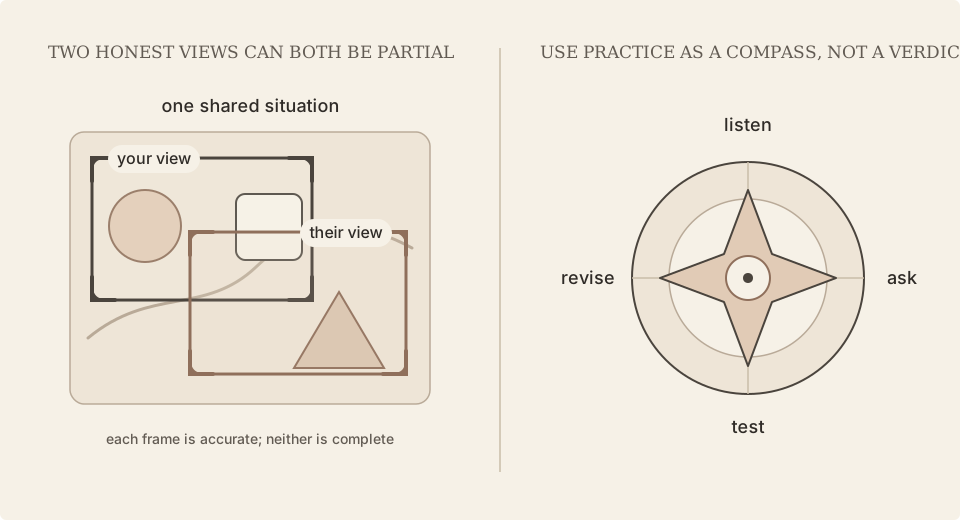
- Triangulate and validate. One viewpoint gives you a line; several give you a location. Ask people who occupy different positions in the situation what they can see. When their accounts conflict, look for the conditions that could make each account locally true.
- Ask questions, make connections. Trace the situation through people, incentives, routines, and dependencies. “Why?” can sound like a demand for a defense. “What makes that the sensible choice from where you sit?” is more likely to reveal the system around the choice.
- Disrupt routines. Beliefs hide inside repeated behavior. Take a different route, travel somewhere that makes you navigate, learn an unfamiliar physical skill, cook without your usual recipe, reverse roles in a meeting, or remove one default step. The point is not novelty for its own sake. It is to create fresh evidence about what is possible. Adult brains remain plastic: learning to juggle produced temporary structural changes in areas involved in visual motion (
Draganski et al., 2004), while extensive navigation experience in London taxi drivers was associated with regional differences in the hippocampus (
Maguire et al., 2000). These studies support sustained learning and practice, not the claim that a vacation alone rewires the brain.
- Act as-if in the here-and-now. Treat a new belief like a costume rehearsal, not a conversion. Borrow it for one scene and see what actions become available. “For this conversation, what would I do if I believed they were trying to help?” The result is evidence; you can keep, revise, or discard the belief afterward.
- Make sense with stories. Narrative turns a list of facts into a world you can act inside. It decides where the sequence begins, what caused what, who had a choice, and what the ending means. Treat the plot as a hypothesis: which facts did it include, which did it leave outside the frame, and what different plot could also explain them? Before acting, write one other story that fits the same facts. The goal is not to invent a kinder answer. It is to remember that your first answer was assembled.
- Evolve yourself. Any change you want from a system may ask something from you too: less control, a lost advantage, an apology, or a new self-description. Name that price. Otherwise it is easy to call for change while arranging to remain unchanged.
The point is not to become belief-free. Compression is understanding: we select, connect, and name because we cannot hold the whole world at once. The better aim is to hold beliefs as editable tools: use the map, notice its edges, and watch for the moment identity turns a working model into a locked door.